One in five of all health care facilities have no basic water services.
We aim to change that.


Learn more about WHO and UNICEF’s work to improve WASH in health care facilities.
The latest data (2025) continues to highlight major global gaps in WASH services

72%
of health care facilities had basic hygiene services

85%
of health care facilities had a basic water service

40%
of health care facilities meet the requirements for basic sanitation
This report presents, for the first time, global estimates for all five basic service areas, including the first estimates for basic sanitation and environmental cleaning.
Read the report here
Explore the data on the JMP’s interactive portal
Summary of the 2025 Global Progress Report
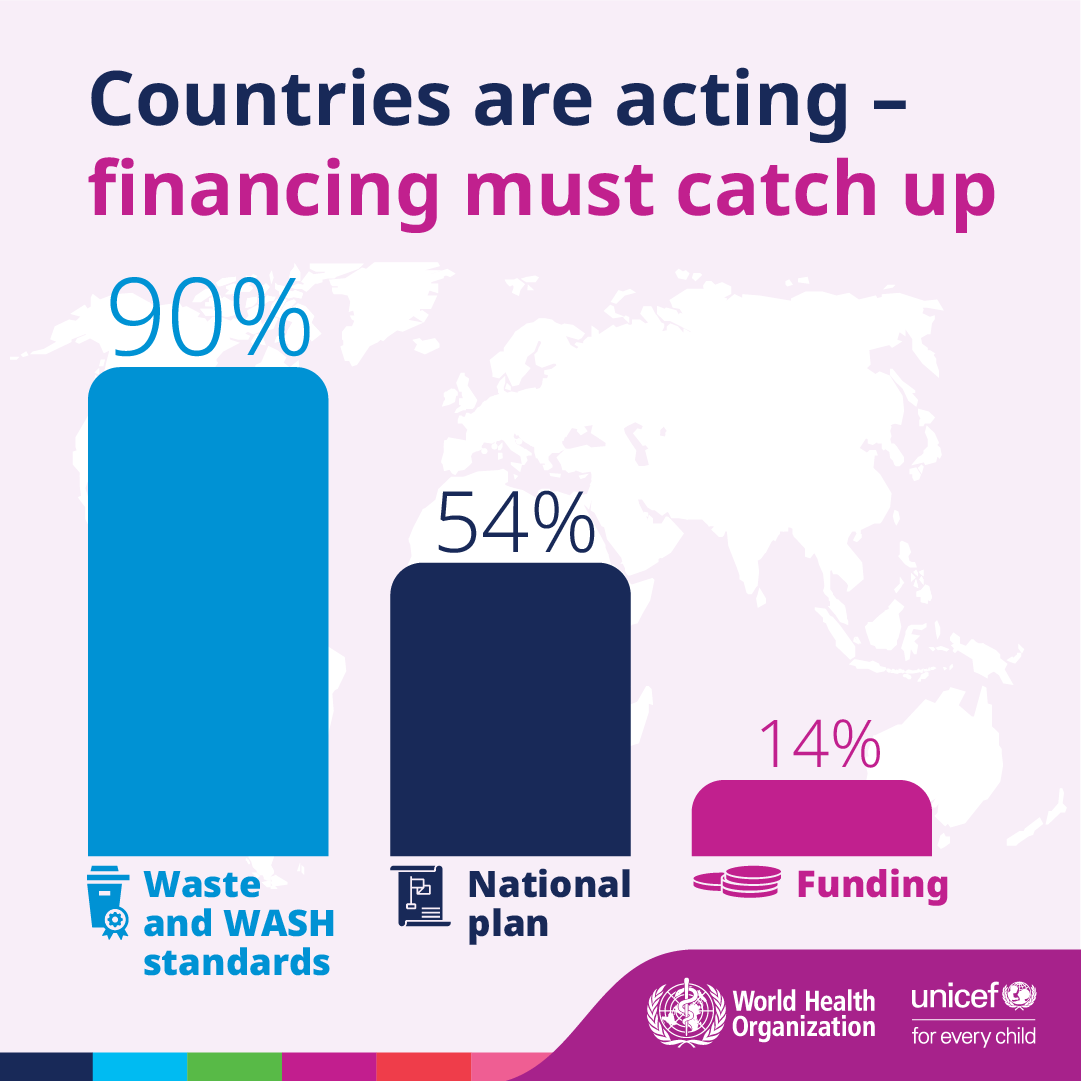
Reporting on country progress in implementing national actions (“practical steps”) articulated in the 2023 UN Resolution.
A record 101 countries are reporting and acting to strengthen WASH, waste and electricity in health care facilities, signaling unprecedented momentum.
81% of countries are taking action to strengthen their systems, including in the Least Developed Countries, demonstrating a readiness to implement and sustain WASH, waste and electricity services.
While a majority countries are undertaking baseline assessments and developing guidelines, only 14% have costed roadmaps with identified financing.
We are often given the excuse that public health problems are too costly to fix, but we now understand that providing basic WASH and energy to health care facilities, while non-negotiable is also affordable. We have no excuses and time is running out. Basic infrastructure is a prerequisite to quality of care. and is essential for life-saving practices
WHO Director of the Department of Environment, Climate Change and Health, Dr Maria Neira, 2023.
Eight Practical Steps to Achieve Universal Access to Quality Care

Conduct situational analysis of enabling environment for WASH in health care facilities (specifically health and WASH policies, governance structures, institutional arrangements, funding streams and stakeholders). Assess WASH coverage and compliance.
Related resources: Cambodia Situation Analysis and WASH Assessment in the Gaza Strip

Set detailed targets (with a national costed roadmap) to address gaps, and estimate costs (capital investments, rehabilitation and recurrent costs). A joint WASH and health taskforce or technical working group is an effective mechanism to help set these targets and develop a roadmap.
Related resources: Ghana National Strategy for WASH-IPC in HCF

Develop standards (a set of requirements that dictate the infrastructure and resources necessary to provide sustainable WASH services) and implement using accountability mechanisms (regulation, accreditation, licensing, community scorecards, feedback mechanisms).
Related resources: Guidelines for Climate-Resilient and Environmentally Sustainable Health Care Facilities in Fiji

Select, install, operate, maintain and improve WASH infrastructure, (including through use of WASH FIT) to ensure sufficient, functioning WASH services are available.
Related resources: Case studies of WASH FIT implementation

Track the status or progress of WASH interventions by monitoring and reviewing indicators on a regular basis, including through national health monitoring information systems.
Related resources: Uganda HMIS Review Report

Invest in a well-trained and well-supported health workforce to enable health systems to perform well and to respond appropriately to challenges.
Related resources: Zambia IPC-WASH Training Manual

Give community members and organizations agency in decision-making and management of services to ensure that health care facilities provide the level of care that citizens deserve and expect.
Related resources: Focus Group Discussions in Indonesia

Generate evidence to understand the problem and what to do about it and scale-up proven improvement approaches.
Related resources: Implementing the Clean Clinic Approach Improves Water, Sanitation, and Hygiene Quality in Health Facilities in the Western Highlands of Guatemala
Water, sanitation and hygiene is a fundamental human right. There is no place where such services are more important, than in health care facilities…I call on all countries and national authorities to act now and invest in universal WASH in health care facilities.
Madam Fabiola Yáñez, First Lady of Argentina